Hello and welcome to the February Newsletter – the days are definitely drawing out again! I hope your lambing/preparations for lambing are going well – weather has not been too bad.
This month, Russell is talking about the cost of lameness in cattle. It’s a sobering read, plenty of reasons to treat asap, and even better, avoid.
As many of you will have already noticed, we are having problems sourcing some of our drugs. The reasons are many and varied, and some of the problems come and go. We are having a prolonged problem with drugs containing amoxicillin (long-acting white penicillin). This is our standard medication around lambing so if you are phoning to order, it is likely that the receptionists will suggest a chat with one of the vets to determine what you are using it for and which drug will suit as a replacement. Other drugs that are a bit iffy include Scabigard and as last year, early ordering of Enzovax and early pre ordering of Toxovax is advisable. The other drug worth a reminder at this point is the bluetongue vaccine Bultavo – surveillance over the winter has shown some spread closer to us – in Devon and Cornwall, and with the vector period approaching fast, vaccination is advisable. Again, speak to any of the vets if you want more information.
The lambing course is taking place on Saturday 14th February at Colliers Adventure Farm Nelson. We still have two places available. The course is very useful for all levels of experience. If you would like to attend, please phone the office. The Antibiotic Resistance meeting on the 26th Feb is currently full but we have a reserve list in case anyone drops out.
Some excellent news now – for those of you who have not heard, Morgan and husband Tom have had a little girl. She arrived safely in the middle of January. We’re all looking forward to meeting baby Hanks.
How is cattle productivity affected by lameness?
No matter how much we want cattle to stay sound, lameness cases still occur. There are obvious costs associated with lameness – trimming, medicines, time. However, the long-term effects of lameness begin months before the cow is detected as lame, and can persist for the rest of the cow’s life. For beef cattle, costings work differently – there is no lost income if milk cannot be sold but reduced milk production means a smaller calf, and reproductive effects e.g. not getting back in calf, are much more important in block calving herds.
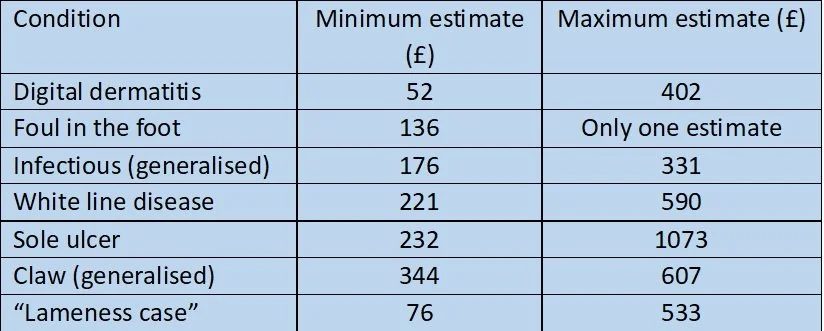
Table 1 – some common conditions and cost estimates. Costs have been adjusted to today’s prices
As you can see, calculating the cost of a case of lameness is difficult but even the minimum estimates make unpleasant reading.
We can group the effects of lameness into three categories – reduced milk production, poor reproductive performance and increased cull risk, usually due to repeat cases. These categories apply whether the herd is dairy or beef, and even apply to sheep. Each category accounts for around a third of the ‘hidden’ losses caused by lameness.
The reduction in milk production due to lameness begins up to 4 months before a cow is visibly detected as lame, and can continue for up to 5 months after successful treatment. Yields can be reduced by 2.7kg/cow/day for the duration of the lameness, meaning cows affected by sole ulcers lose 8% of their lactation yield and white line disease lose 5%.
Lame cows are also more likely to be thin. However, in most cases, being lame doesn’t make the cow thin, it is the cow being thin that makes her go lame. The loss of condition means that the fat pad (see previous newsletters) becomes thin making sole bruising, ulcers and white line disease (collectively claw horn lesions – CHL) more likely. Up to 10% of lameness in some herds can be attributed to prior weight loss in the cows.
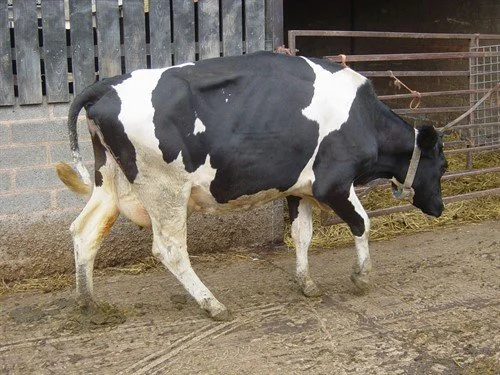
Lame cow: Image courtesy of NADIS
The effects on reproduction are significant. In year-round calving herds, there is more time for the cow to recover but in a block calving system i.e. most suckler herds, failing to get in calf can often lead to a cow being culled.
Reproductive performance can be affected by lameness as far back as the end of the previous lactation. This can cause the cow to be slow to resume cycling, and when she does, she is much more likely to have abnormal cycles, both of which affect her ability to breed. It is also worth noting that a significant proportion of cows affected by lameness (up to 30% in some herds) will either be culled before breeding or marked as ‘do not breed’ and never get served.
There are further issues when the fetus tries to implant in the cow. Lameness causes inflammation both in the foot and also systemically, as chemicals are released into the bloodstream to signal that there is an ongoing disease process. These chemicals interfere with the ability of the calf to signal to the cow that it is there, and also affect the uterine environment the calf is growing in. A summary of effects seen in various studies is shown in table 2.
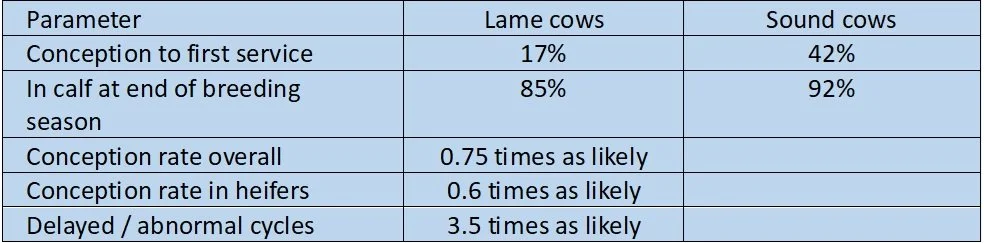
Table 2.
Finally, there is the increased risk of culling for lame cows. Some of these will be enforced culls where the cow does not recover from her episode of lameness, whilst some culls will be voluntary. Overall, the most common reason that lame cows are culled, is that they keep having repeated cases of lameness.
When the lameness records of herds are analysed and combined, it appears that around 80% of lameness can be attributed to a previous case in the same animal, with up to 20% due to lameness more than 4 moths previosuly. This is often a direct recurrence of the same disease in the same claw, but a large number of cows suffer from the same problems in the other leg. In practical terms, when one foot is trimmed, always make sure the other side is done at the same time – after all, both legs will have done the same number of steps.
However, there is some good news – EDPET. This stands for Early Detection and Prompt Effective Treatment. For early detection, this could be a formal mobility score every 2 weeks, or as simple as looking at the cows every day. Prompt effective treatment means just that. Ideally, treatment should be within 48 hours of detecting the lame cow, which often means that waiting for a foot trimmer is too slow. For claw horn lesions, effective treatment means a trim, block and anti-inflammatory. Using the EDPET principle i.e. treating cows that have been lame for 2 weeks, gives a significant improvement in cure rate even when compared to cows that have been lame for only 4 weeks.
This month’s author is Russell. If you would like to further information on anything mentioned in the article, please contact the office to speak to Russell or one of the other vets.
Finally, there is the increased risk of culling for lame cows. Some of these will be enforced culls where the cow does not recover from her episode of lameness, whilst some culls will be voluntary. Overall, the most common reason that lame cows are culled, is that they keep having repeated cases of lameness.
When the lameness records of herds are analysed and combined, it appears that around 80% of lameness can be attributed to a previous case in the same animal, with up to 20% due to lameness more than 4 moths previosuly. This is often a direct recurrence of the same disease in the same claw, but a large number of cows suffer from the same problems in the other leg. In practical terms, when one foot is trimmed, always make sure the other side is done at the same time – after all, both legs will have done the same number of steps.
However, there is some good news – EDPET. This stands for Early Detection and Prompt Effective Treatment. For early detection, this could be a formal mobility score every 2 weeks, or as simple as looking at the cows every day. Prompt effective treatment means just that. Ideally, treatment should be within 48 hours of detecting the lame cow, which often means that waiting for a foot trimmer is too slow. For claw horn lesions, effective treatment means a trim, block and anti-inflammatory. Using the EDPET principle i.e. treating cows that have been lame for 2 weeks, gives a significant improvement in cure rate even when compared to cows that have been lame for only 4 weeks.
This month’s author is Russell. If you would like to further information on anything mentioned in the article, please contact the office to speak to Russell or one of the other vets.

Please make note of our new email address info@swfv.uk